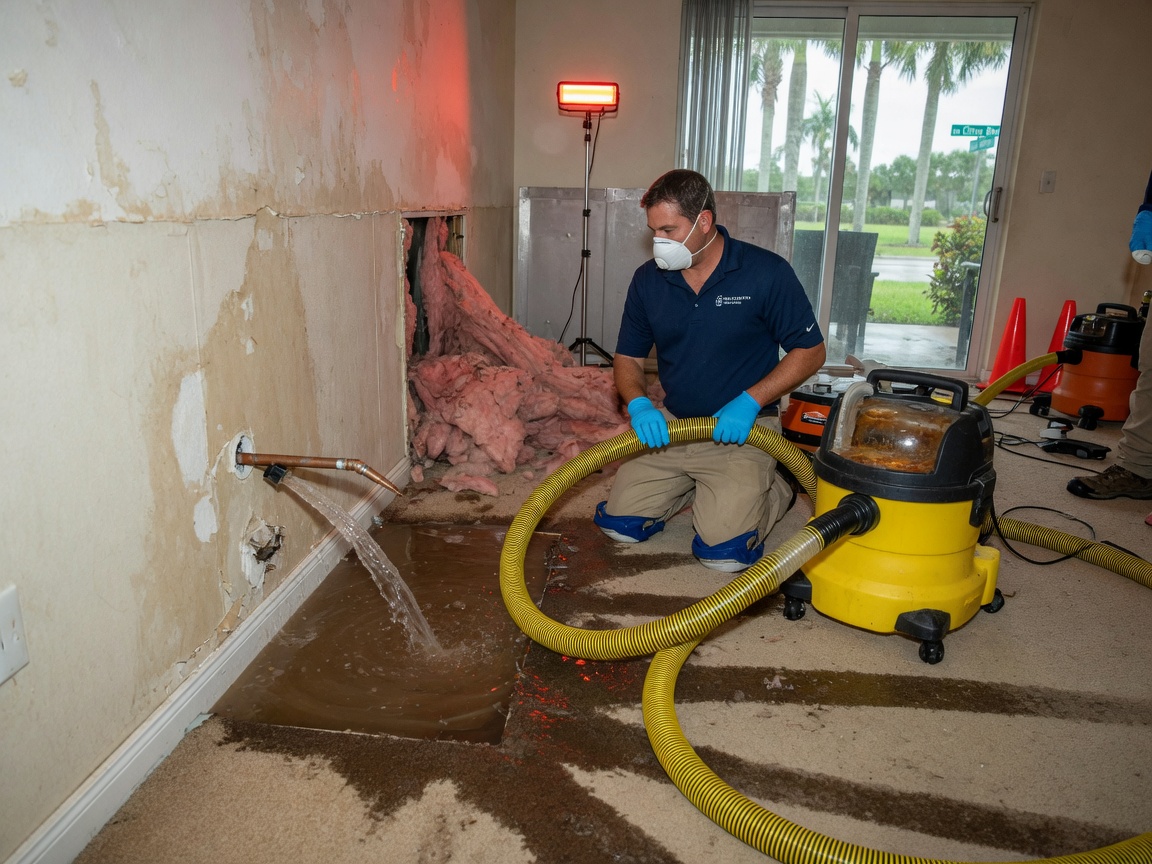
Jacksonville's spread-out housing stock, from Riverside bungalows to military-adjacent subdivisions near the St. Johns River, often sees copper and galvanized lines fail where decades of humid subtropical summers accelerate corrosion. Crews navigate I-10 and US-1 corridors to reach properties where a single burst can flood crawl spaces before mild winter nights allow unnoticed seepage. Military housing clusters and port-area builds add layers of slab and pier-and-beam construction that trap water differently than inland Florida neighborhoods.
Burst Pipe Water Extraction in Jacksonville — What We Handle
- ✓Larger lot sizes and older Riverside stock mean extraction often requires longer hose runs and targeted drying under raised foundations.
- ✓Proximity to the river and high water table speeds secondary moisture migration into walls compared with drier inland counties.
- ✓Traffic on I-95 and FL-202 during peak hours forces crews to stage equipment for rapid off-peak mobilization.
Port St. Lucie homes built on concrete slabs often see supply-line bursts under kitchens or bathrooms where older PVC joints fail from age or shifting soil. Water travels under the slab and rises through expansion joints or tile grout, saturating subflooring and base cabinets before homeowners notice. Extraction requires slab-edge access points and moisture meters to map hidden spread rather than surface drying alone.
Heavy afternoon thunderstorms common in St. Lucie County can overwhelm already compromised pipes, pushing water into wall cavities along the east side of homes facing prevailing winds. Technicians cut strategic weep holes at the base of drywall and use negative-air machines to pull moisture from insulation without full demolition when the leak is caught early. In neighborhoods like St. Lucie West, where many homes date to the 1990s, we see repeated failures at the water heater shut-off valves located in garages.
How It Works in Jacksonville
- 1
On-Site Assessment
Technician arrives with moisture meters and thermal imaging to trace water paths from the burst point through slab or walls.
- 2
Water Removal
High-volume pumps and wand extractors pull standing water while protecting unaffected flooring in Port St. Lucie homes.
- 3
Hidden Moisture Extraction
Strategic cuts and negative air allow drying of cavities without unnecessary demolition in slab-on-grade construction.
- 4
Final Moisture Verification
Multiple depth readings confirm dryness before equipment removal and homeowner walkthrough.
Burst Pipe Water Extraction Services We Offer in Jacksonville
✓Slab Leak Water Extraction
Locate and remove water that has traveled beneath concrete slabs after a supply pipe burst in Port St. Lucie kitchens and baths.
✓Wall Cavity Drying After Pipe Burst
Cut controlled access points and extract moisture from insulation and framing when a burst occurs inside interior walls.
✓Garage Water Heater Burst Cleanup
Contain and remove standing water from garage slabs when the shut-off valve or flex line fails on older units.
✓Attic Pipe Burst Extraction
Pull water from attic insulation and ceiling joists after supply lines above living spaces rupture during heavy rain periods.
✓Base Cabinet and Flooring Extraction
Remove saturated particle board and underlayment in kitchens where burst pipes have wicked into cabinet bases and vinyl plank.
Serving All of Jacksonville
We regularly handle burst pipe water extraction jobs near:
- 📍Jacksonville Landing
- 📍Cummer Museum
- 📍St. Johns River
- 📍EverBank Field
- 📍Kingsley Plantation
Burst Pipe Water Extraction Pricing in Jacksonville
Pricing depends on access difficulty, volume of water, and number of affected rooms.
Want the full picture of this service? See our Burst Pipe Water Extraction page, or everything we do in Jacksonville, FL.